

R.P.M. Davis
1874–1964
Roy Paul Miller Davis brought together industry, banking, invention, and community promotion in a career that stretched far beyond the golf course. His importance to ALCC begins with the organizing meeting he helped convene at Mount Union High School on August 26, 1924, but the experience that led him there had been built over decades.
Archival Princeton records place Davis with the Class of 1898 and state that he studied there for three years. A later Princeton alumni memorial described him as a manufacturer, banker, mineral expert, real-estate investor, and inventor. It listed leadership positions with United States Refractories Corporation, Refractories Machine Manufacturing Corporation, Kistler Real Estate and Improvement Company, and the Central National Bank of Mount Union. Those overlapping interests help explain why Davis imagined the Colony Club as both a recreational institution and a regional development project.
Industry and Invention
Davis’s strongest documented inventions grew directly from Mount Union’s refractory industry. In 1924, the United States Patent Office granted him a patent for an automatic brickmaking machine designed to increase production while reducing strain on molds and their supporting equipment. A second 1924 patent covered a related method and apparatus for forming brick. These were not hobby inventions; they addressed the machinery at the center of the local industrial economy.
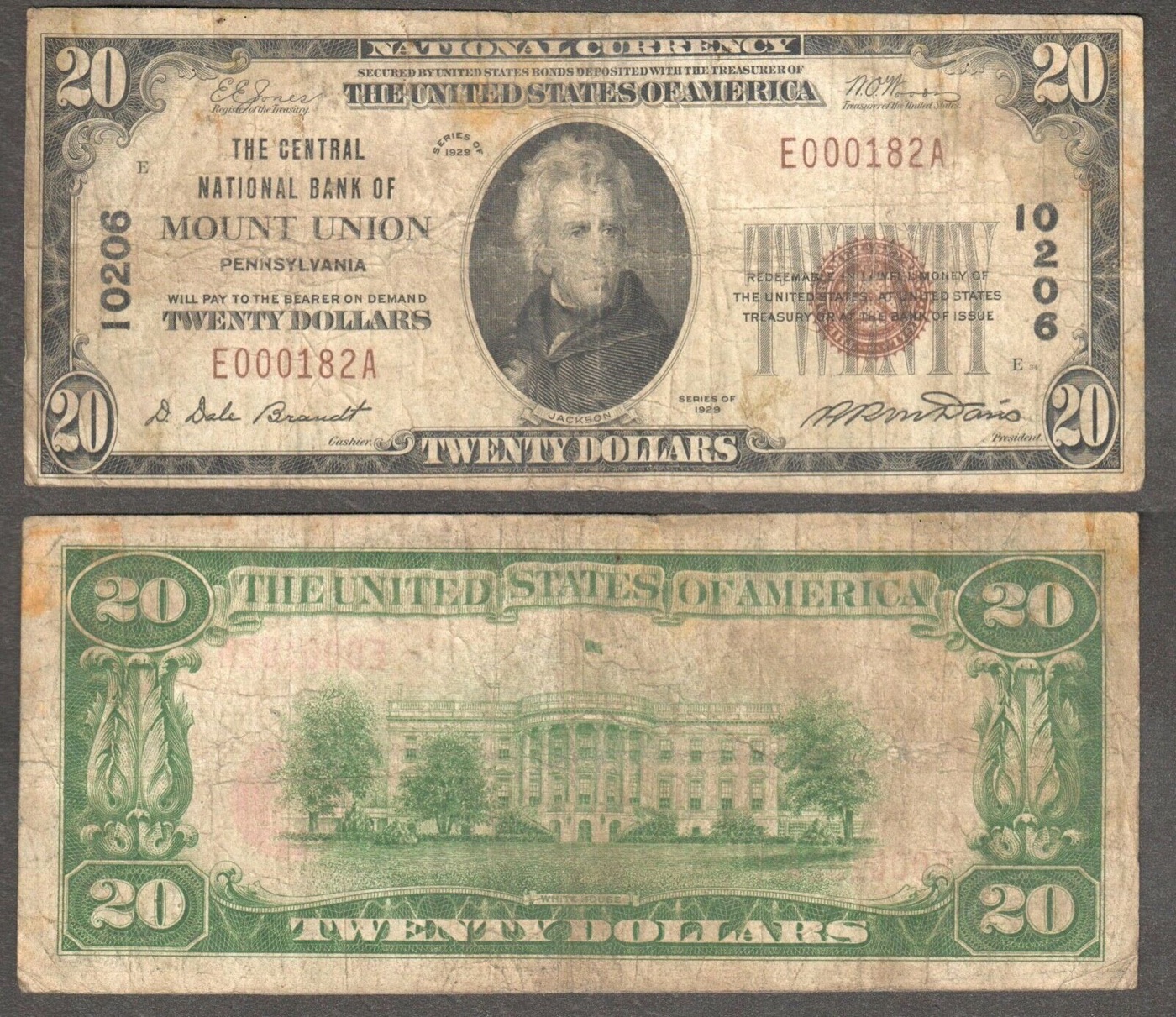
Davis also served as president of the Central National Bank of Mount Union. A surviving Series of 1929 twenty-dollar national-bank note bears his signature as president, preserving a direct physical connection to that part of his career.
Service During the 1918 Influenza Epidemic
Davis’s community role became especially visible during the influenza epidemic of 1918. Contemporary reporting described approximately 100 cases among Kistler’s population of about 800. The school was converted into an emergency hospital and reached 21 patients within its 24-bed capacity. The report identified Davis among the leaders of the relief effort as nurses and other workers cared for the sick under extremely difficult conditions.
This episode adds an important dimension to his record. Six years before the Colony Club organizing meeting, Davis was already using his position and industrial resources to respond to a community emergency.
An Ambitious Club and Summer Community
Three days after the August 1924 organizing meeting, the Mount Union Times reported 128 stockholders and charter members. The proposal joined a country club to a summer-cottage development along the Juniata River. Golf was central, but Davis’s plan also included cottage lots, rental homes, roads, water and sewer service, a clubhouse, swimming, tennis, boating, fishing, and trapshooting.
By August 1926, newspaper reporting described 585 acres assembled from three farms. Davis’s own prospectus promoted roughly 600 acres and explained how land sales, rentals, visitors, dues, and recreation were expected to support the development. Those figures document the scale of his vision; they do not prove that every proposed cottage or lot was completed.
A Complicated Financial Record
Davis’s central role also places him at the heart of the project’s financial story. In a December 1929 public letter, he distinguished the Juniata Valley Realty Corporation, which owned and developed land, from the Colony Club, which operated the recreational institution. He discussed borrowing, credit pressure, and threats of bankruptcy while defending both organizations. The letter is valuable evidence of his position, but it was not an independent financial audit.
In 1930, stockholders considered increasing authorized indebtedness while the development continued planning additional cottages. The surviving record therefore shows both achievement and exposure: Davis helped create an extraordinary regional recreation community, but its business structure was under strain well before the destructive flood of 1936.
Sta-Neet and a Later California Career
Later in life, Davis became closely associated with the Sta-Neet Corporation and its adjustable razor-and-comb hair trimmer. Contemporary publicity credited the product with more than one million sales and described Davis as the driving businessman behind its rapid commercial growth. A Princeton alumni memorial also credited his California operation with employing workers with disabilities, including blind assembly workers.
The invention credit requires precision. The principal 1949 Sta-Neet patent names Sanford E. A. Sanders as inventor and Sta-Neet Corporation as assignee—not Davis. Davis did, however, hold or acquire rights in related hair-trimmer designs, including a later patent that references his own pending application. He should therefore be remembered as Sta-Neet’s president, promoter, and an active participant in its product development, rather than as the sole inventor of the original patented comb.

Blue Springs and Davis’s Legacy
Davis and his family also maintained a Juniata River estate known as Blue Springs. Newspaper accounts connect the property with gardens, family weddings, and river recreation. Local recollections describe a bridge linking the estate side of the river with the Colony Club grounds. The former Davis property later became part of the land associated with Beacon Lodge, the camp developed to serve blind and visually impaired people.
Davis’s legacy is consequently larger—and more complicated—than a single founding meeting. He helped modernize an important local industry, led a Mount Union bank, responded during a public-health crisis, pursued inventions and businesses across the country, and promoted the riverside development from which today’s American Legion Country Club emerged. His ambitions sometimes outran the enterprise’s finances, but the institution he helped set in motion survived them.
For the full account of the development and its finances, see The Colony Club Story.
Sources
- Harrisburg Telegraph, October 23, 1918, page 7 — Kistler emergency hospital and Davis’s role during the influenza epidemic.
- Rand McNally Bankers Directory, January 1920 — Davis as president of the Central National Bank of Mount Union.
- United States Patent No. 1,498,614, “Automatic Machine for Making Bricks”, granted June 24, 1924.
- United States Patent No. 1,501,479, “Method and Apparatus for Making Brick”, granted July 15, 1924.
- Mount Union Times, August 29, 1924, page 4 — organizing meeting, stockholders, and initial development proposal.
- Mount Union Times, August 27, 1926, pages 1 and 12 — Davis prospectus and business plan.
- Mount Union Times, December 6, 1929, pages 1 and 20 — Davis’s public financial letter.
- United States Patent No. 2,461,444, “Haircutting Comb”, granted February 8, 1949.
- United States Patent No. 2,512,289, “Hair Trimmer”, granted June 20, 1950.
- Princeton alumni family record and memorial for Roy Paul Miller Davis, preserved in the club research archive.